

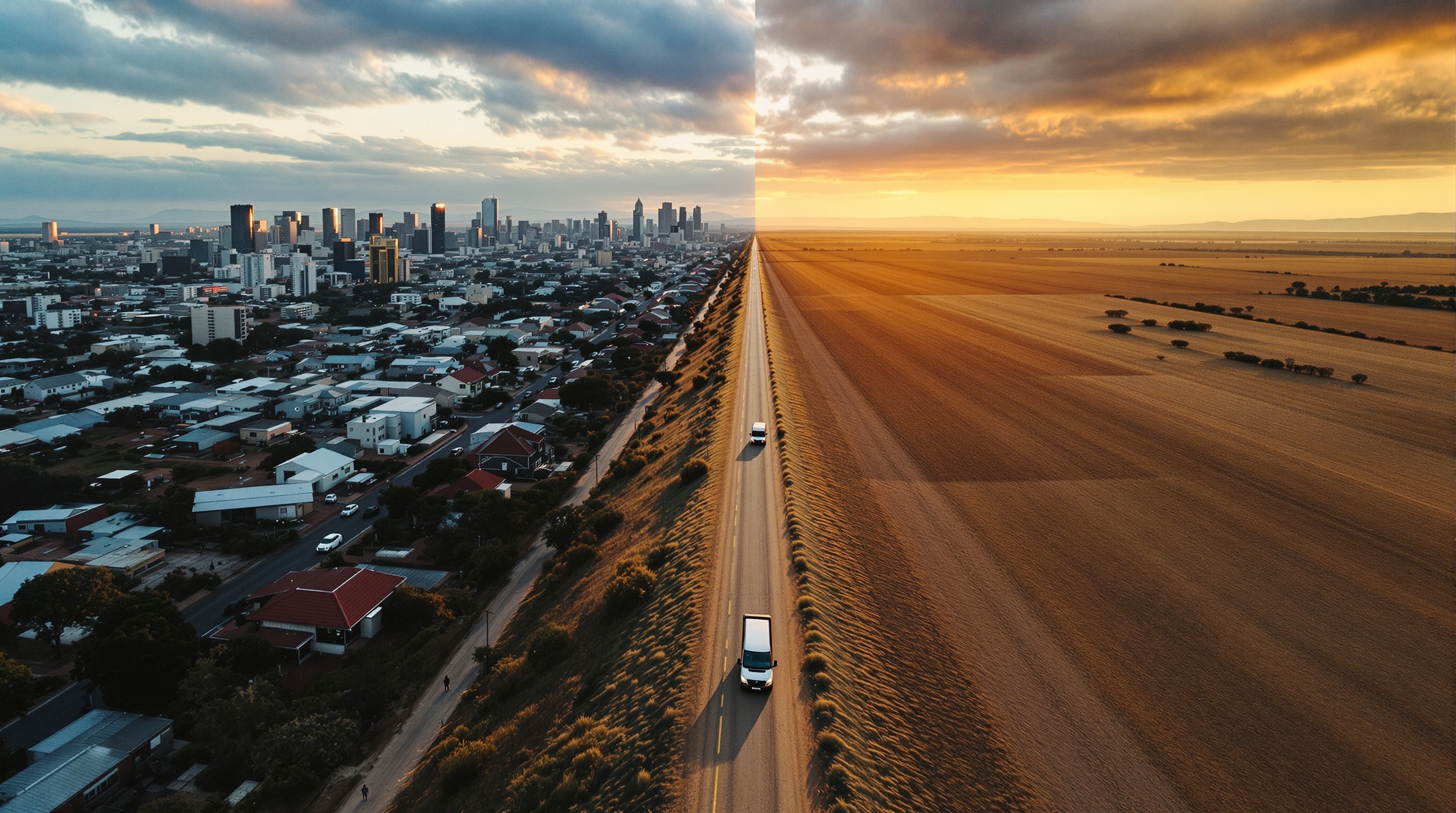
South Africa's Geography Problem
South Africa is the 24th largest country in the world by land area, but courier networks are built around 8 major metros. If your customer lives in Pongola, Kuruman, De Aar, Giyani, or any of the hundreds of towns between the big cities, the courier doesn't have a regular route there. That means a special trip — and that special trip gets billed as a remote area surcharge. For small businesses selling nationwide, these surcharges can silently add thousands to monthly courier bills.
What Exactly Is a Remote Area Surcharge?
A remote area surcharge (sometimes called an "outlying area fee," "extended delivery area surcharge," or "rural delivery levy") is an additional fee couriers add when the delivery destination falls outside their standard delivery network. It covers the extra fuel, driver time, and vehicle cost of going somewhere the courier doesn't normally go.
In South Africa, remote area surcharges typically range from R40 to R350 per consignment — but can exceed R500 for extremely isolated locations. The surcharge is added on top of the base rate, and it applies regardless of whether you're sending a 500g padded envelope or a 10kg box.
How Couriers Define "Remote" in South Africa
Each courier uses slightly different definitions, but they generally fall into three categories:
| Zone Classification | What It Means | Typical Surcharge | Example Towns |
|---|---|---|---|
| Metro (Zone A) | Within major city municipal boundaries | R0 (included) | JHB, CPT, DBN, PTA, Sandton, Centurion |
| Secondary City (Zone B) | Regional towns with regular courier routes | R0 - R60 | Bloemfontein, East London, Nelspruit, Polokwane, Kimberley |
| Extended (Zone C) | Towns with 2-3 deliveries per week, not daily | R60 - R150 | Queenstown, Ladysmith, Tzaneen, Mossel Bay, Mafikeng |
| Remote (Zone D) | Towns without any regular courier service | R150 - R350+ | Kuruman, Musina, Giyani, Kokstad, Springbok, Pongola |
| Deep Rural / Farm | No street address, farm roads, informal settlements | R200 - R500+ | Rural Free State farms, Karoo sheep stations, Limpopo game farms |
The Map Test: Is Your Customer "Remote"?
Here's a rough rule of thumb for South Africa: if the delivery address is more than 50km from a major courier depot (typically located in Johannesburg, Cape Town, Durban, Pretoria, Bloemfontein, Port Elizabeth, East London, or Nelspruit), there's a good chance it attracts a surcharge. Even towns within 50km of a metro can be classified as remote if they're not on a standard daily delivery route.
Real South African Remote Area Surcharge Pricing
Let's look at actual surcharges for real South African routes. These are based on typical courier rate cards and aggregator platforms.
| Origin | Destination | Base Rate | Remote Surcharge | What You Actually Pay | Increase |
|---|---|---|---|---|---|
| Johannesburg | Kuruman (NC) | R145 | R185 | R330 | +128% |
| Durban | Mtubatuba (KZN) | R110 | R130 | R240 | +118% |
| Cape Town | Springbok (NC) | R165 | R210 | R375 | +127% |
| Pretoria | Giyani (Limpopo) | R130 | R160 | R290 | +123% |
| Bloemfontein | De Aar (NC) | R95 | R145 | R240 | +153% |
| Johannesburg | Musina (Limpopo) | R170 | R240 | R410 | +141% |
| Gqeberha | Mthatha (EC) | R120 | R140 | R260 | +117% |
| Pretoria | Thohoyandou (Limpopo) | R155 | R175 | R330 | +113% |
The Aggregator Trap: Worse for Remote Areas
Courier aggregator platforms often don't display remote area surcharges during the booking process. They quote a base rate, then add the surcharge after — sometimes days later when the courier processes the order. By then, you've already charged your customer R95 for shipping and now you're paying R210. Always check if the destination attracts a surcharge before quoting delivery to your customer, especially when using aggregator platforms.
Why Couriers Charge Remote Area Surcharges (It's Not a Scam)
Remote area surcharges frustrate business owners, but they exist for legitimate economic reasons. Here's what the courier's cost structure actually looks like:
The Economics of a Delivery to Pongola
| Cost Factor | Metro Delivery (Johannesburg) | Remote Delivery (Pongola) |
|---|---|---|
| Distance from depot | 5-25 km | 380+ km |
| Parcels per trip | 30-60 stops | 1-3 stops |
| Cost per parcel (amortised) | R25 - R45 | R180 - R350+ |
| Daily trips available | Multiple daily | 1-2 per week |
| Return trip utilisation | High (collects new parcels) | Often empty return |
In Johannesburg, a delivery van does 30-60 stops per day on a tight loop. The cost per parcel is low because it's shared across dozens of deliveries. In Pongola, the courier might drive 380km from the nearest depot, deliver a single parcel, and drive back empty. The per-parcel economics are completely different — and the surcharge reflects that.
How Different Courier Types Handle Remote Areas
Not all couriers treat remote areas the same way. Some are much friendlier to outlying deliveries than others.
| Courier Type | Remote Area Policy | Typical Surcharge | Best For |
|---|---|---|---|
| Same-day dedicated courier | Charges per km or per hour — no separate "remote" label but cost reflects distance | Effectively built into the rate | Urgent single deliveries to any location |
| Overnight / express | Zone-based: national hub model means most towns have a delivery schedule | R60 - R200 | Reliable next-day to most towns |
| Economy / road freight | Least affected — LTL consolidation makes small-town deliveries viable | R40 - R120 | Cost-effective for non-urgent deliveries |
| Courier aggregator | May not show surcharge at checkout — added after booking | R60 - R250 (varies by underlying courier) | Convenient but watch for surprise charges |
| Direct courier (own fleet) | Some have fixed nationwide rates with no remote surcharge | R0 - R80 (if any) | Business accounts with consistent remote delivery needs |
The Provinces Where Remote Surcharges Hit Hardest
South Africa's geography means some provinces are far more affected by remote area surcharges than others. Here's the breakdown:
Northern Cape
The worst-affected province. Only Kimberley has regular daily courier service. Towns like Kuruman, Upington, Springbok, De Aar, and Pofadder all attract surcharges of R120-R250+. With a population density of just 3 people per km², it's the most expensive province for courier delivery in South Africa.
Limpopo
Polokwane has good coverage, but towns like Giyani, Thohoyandou, Musina, Lephalale, and Phalaborwa are far from courier hubs. Surcharges typically R100-R240. The province's north-south stretch means deliveries from Johannesburg can travel 500+ km to reach the Zimbabwe border area.
Eastern Cape
Outside of Gqeberha and East London, the former Transkei region is particularly challenging. Towns like Mthatha, Queenstown, Lusikisiki, and Cofimvaba attract surcharges of R80-R180. The terrain — winding mountain passes and poor road infrastructure — adds time and cost.
KwaZulu-Natal
Durban-to-interior routes are well-served, but the Zululand region — Pongola, Nongoma, Ulundi, Ingwavuma — and the Drakensberg foothills attract surcharges of R80-R160. The distance from Durban's hub combined with challenging terrain through the Valley of a Thousand Hills adds cost.
The Business Owner's Cheat Sheet: Town-by-Town Remote Status
Here's a quick reference for common towns that frequently attract remote area surcharges:
| Province | Towns Likely Attracting Remote Surcharges | Nearest Courier Hub | Approx. Distance from Hub |
|---|---|---|---|
| Northern Cape | Kuruman, Upington, Springbok, De Aar, Pofadder, Calvinia, Prieska, Carnarvon | Kimberley / Bloemfontein | 200-550 km |
| Limpopo | Musina, Giyani, Thohoyandou, Phalaborwa, Lephalale, Louis Trichardt | Polokwane / Pretoria | 150-500 km |
| Eastern Cape | Mthatha, Lusikisiki, Cofimvaba, Mount Frere, Aliwal North, Cradock | East London / Gqeberha | 180-400 km |
| KwaZulu-Natal | Pongola, Nongoma, Ingwavuma, Manguzi, Underberg, Himeville | Durban / Pietermaritzburg | 180-450 km |
| North West | Vryburg, Schweizer-Reneke, Zeerust, Ganyesa, Taung, Christiana | Klerksdorp / Mafikeng | 120-250 km |
| Mpumalanga | Piet Retief, Ermelo rural, Badplaas, Sabie, Pilgrim's Rest | Nelspruit / Witbank | 80-200 km |
Good News: Most Secondary Towns Are Now "Standard"
Courier networks in South Africa have expanded significantly since 2020. Towns like Nelspruit, Polokwane, Rustenburg, Witbank, Potchefstroom, and Pietermaritzburg — which attracted remote surcharges 10 years ago — are now standard delivery zones. The e-commerce boom has forced couriers to extend their networks. If you haven't checked a town's status recently, it might no longer be classified as remote.
9 Strategies to Minimise Remote Area Surcharges
1. Ask for a fixed nationwide rate
If you ship more than 20 parcels per month to remote areas, negotiate a flat nationwide rate with your courier. Many business accounts offer fixed pricing regardless of destination — the courier absorbs the remote risk across your total volume. The savings on 20 remote deliveries alone can justify a business account.
2. Check zone maps before quoting customers
Most couriers publish delivery zone maps. Before quoting "R95 delivery nationwide" on your website, check if your target towns are in standard zones. Either build zone-aware shipping rates into your checkout or quote delivery on a per-order basis for remote areas.
3. Use economy / road freight for remote deliveries
Economy road freight attracts the lowest remote area surcharges because LTL consolidation makes small-town deliveries viable. If the delivery isn't urgent, switching from overnight to economy can save R80-R150 in remote area surcharges — even before the base rate savings.
4. Consolidate remote deliveries
If you have multiple customers in the same remote area, ship their orders on the same day. Courier remote surcharges are per-stop, not per-parcel — so sending 3 parcels to Kuruman in one trip costs far less than 3 separate deliveries on 3 different days.
5. Use pickup points or lockers
Many couriers now offer parcel locker networks or pickup points in regional towns. Delivering to a central locker in Kuruman or Musina often doesn't attract a remote surcharge — because the courier already services that locker regularly. Your customer makes the final short trip instead of the courier.
6. Build the surcharge into your product price
If 25% of your orders go to remote areas, don't surprise customers with a R180 shipping fee at checkout. Build an average remote surcharge into your product pricing and offer "free delivery nationwide." It's psychologically cleaner and converts better.
7. Use SA Post Office for the most remote areas
It's slower and less reliable, but SAPO delivers to post boxes in every town in South Africa without a remote surcharge. For low-value, non-urgent items going to extremely remote areas, post office delivery costs a fraction of courier. Just be upfront about delivery timelines (2-4 weeks).
8. Negotiate a volume-based remote cap
On a business account, negotiate a cap: "no single remote area surcharge exceeds R80 regardless of destination." Couriers will often agree to this for accounts shipping 100+ parcels per month because the surcharge gets averaged into your overall rate.
9. Check multiple couriers per remote destination
Courier A might classify Mooi River as remote (R160 surcharge), while Courier B considers it a standard route (R0 surcharge). Different couriers have different depot networks, and the "remoteness" of a town depends entirely on proximity to that courier's specific hub locations. Always compare.
Five Mistakes That Amplify Remote Area Costs
Mistake 1: Advertising "free delivery nationwide" without zone limits
If you advertise free delivery to "anywhere in South Africa" and a customer in Pofadder orders a R200 item that costs R350 to deliver, you lose R150 on the sale. Either restrict free delivery to metro areas, build the average remote cost into your prices, or charge a remote area fee transparently.
Mistake 2: Trusting the aggregator's initial quote
That R89 quote on the aggregator platform looks great — until the courier processes your booking and the actual charge is R215. Always use the courier's own rate calculator (not the aggregator's) for remote destinations, or call and confirm directly.
Mistake 3: Assuming the surcharge is a one-off
Remote area surcharges apply to every delivery, not just the first one. If you ship 10 parcels a month to Giyani at R160 surcharge each, that's R1,600/month — R19,200/year — in surcharges alone. Small per-parcel charges add up fast. Do the annual math.
Mistake 4: Not passing on the remote surcharge to the customer
Many small business owners feel awkward charging extra for remote delivery and eat the cost themselves. But this is a legitimate cost of doing business with that customer. Set up zone-based shipping rates in your store. Customers in Springbok understand that delivery costs more than customers in Sandton.
Mistake 5: Using same-day express for remote areas
Same-day delivery to remote areas is astronomically expensive because it requires a dedicated driver for 400+ km. Unless it's truly urgent, use overnight or economy for remote deliveries. The remote surcharge on a same-day can be R350+ vs R120 on overnight.
What to Ask Your Courier About Remote Areas — Before You Book
Get written answers to these 8 questions before you commit to a courier relationship:
- Do you have a published list of towns that attract remote area surcharges?
- What is the exact surcharge for each zone? (Get the zone map)
- Is the surcharge a flat fee or percentage of the base rate?
- Does the surcharge apply per consignment, per parcel, or per stop?
- How often do you update your zone classifications? (Towns get upgraded as routes develop)
- Do you offer a fixed nationwide rate for business accounts above a certain volume?
- Can I see the surcharge before I confirm the booking? (Not after)
- Do you deliver to the specific address, or only to the nearest town's post office/pickup point?
The Remote Area Calculator: Quick Math for Your Business
Here's a simple way to estimate your annual remote area exposure:
- Count how many deliveries you made to non-metro areas in the last 3 months
- Multiply by the average remote surcharge (use R130 as a baseline if unknown)
- Multiply by 4 to annualise
Example: 15 remote deliveries/month × R130 = R1,950/month = R23,400/year. If a business account with fixed nationwide rates costs R500/month more than your current plan, it saves you R1,450/month — or R17,400/year.
FAQ: Remote Area Surcharges Quick Answers
What is a remote area surcharge on courier deliveries?
A remote area surcharge is an extra fee couriers add when delivering to locations outside their standard delivery network — typically R60 to R350 in South Africa. It covers the additional fuel, driver time, and vehicle cost of reaching towns that don't have regular daily courier service. The surcharge is added to the base delivery rate and applies regardless of parcel size or weight.
Why does my courier charge extra for deliveries to small towns?
Couriers charge extra for small towns because the delivery economics are fundamentally different. In Johannesburg, a driver does 30-60 stops on a compact route. In a small Karoo town, the driver might drive 300km from the nearest depot to deliver a single parcel — and return empty. The per-parcel cost is 5-10x higher, and the surcharge partially offsets this. It's not a penalty — it's a reflection of the real cost of reaching that location.
How do I know if my delivery address attracts a remote surcharge?
Check the courier's delivery zone map (most publish these online), use their rate calculator with the exact delivery address, or call and ask directly. A good rule of thumb: if the town is more than 50km from a major courier depot (Johannesburg, Cape Town, Durban, Pretoria, Bloemfontein, Gqeberha, East London, or Nelspruit), it likely attracts a surcharge. Be especially careful with aggregator platforms that may not display the surcharge until after booking.
Can I avoid remote area surcharges completely?
You can minimise or eliminate remote surcharges by: negotiating a fixed nationwide rate on a business account (most effective for 20+ parcels/month), using economy road freight instead of express, consolidating multiple deliveries to the same remote area into one trip, using parcel lockers or pickup points in regional towns, or — for low-value non-urgent items — using SA Post Office which delivers to every town without remote surcharges.
Which courier has the lowest remote area surcharges in South Africa?
There's no single "best" courier for remote areas because surcharges depend on each courier's specific depot network. A town classified as remote by Courier A (with the nearest depot in Bloemfontein) might be standard for Courier B (with a depot in Kimberley). Always compare multiple couriers for your specific remote destinations. Direct couriers with own fleets often offer more favourable remote area terms than aggregator platforms.
Do remote area surcharges apply to both delivery and collection?
Most couriers charge a remote area surcharge for both collection and delivery if the address is remote. A parcel collected from Pongola and delivered to Johannesburg typically attracts two surcharges — one for the remote pickup and one for the remote delivery (though the metro delivery portion usually has no surcharge). Always confirm whether the surcharge is one-way or round-trip.